![[personal profile]](https://www.dreamwidth.org/img/silk/identity/user.png) chuckro
chuckroThe Ninja Turtles started life as comic book characters, in a parody of dark and gritty superhero comics of the time. (Particularly Daredevil—in certain canons, the ooze that mutated the turtles is the same that blinded Murdock. And there’s the master named Stick/Splinter and the fight against the Hand/Foot. But I digress.) But they rose to popularity as cartoon characters and were established to be a property aimed entirely at children. So Archie Comics got the license to chronicle their further comic-book adventures.
In 1989 I was eight years old, and squarely in the demographic for these guys. I was also already a big comic fan and making weekly trips to the comics shop on top of all the free DC books my dad brought home. So I have a fairly complete collection of these. And I'm going to review and summarize the entire series.
Issues #1-4 directly adapted from the cartoon, taking the stories “The Return of Shredder” and “The Incredible Shrinking Turtles” in two issues each. Dave Garcia handles both the art and the adaptation of a script originally by Christy Marx and David Wise. Garcia doesn’t quite have a handle on good comic pacing and doesn’t really believe in backgrounds, but the art is decent and captures a lot of the action of the cartoon, if in a slightly slowed-down way. The second story ends with Shredder and Baxter Stockman escaping with the 1st Eye of Sarnath (an alien gem with mysterious powers). In the cartoon, this was the first of a four-part collection of episodes where each of the different eyes does something weird and eventually Shredder gets all three, attaches them to his helmet, and makes terrible use of matter-transforming powers until he’s defeated. In this series, the plot is dropped.
Issue #5 marks the introduction of writers Dean Clarrain and Ryan Brown, who’ll generally shepherd the series from here on. I don’t know what was going on behind the scenes, but it seems pretty clear there was an effort to diverge from the TV series but a requirement to use all of the characters they wanted to sell toys for. And so in Issue #5 we meet Man Ray, and in #6 Leatherhead. We also have a brief meeting with Swamp Witch Mary Bones, who transformed Leatherhead with her magic crystal ball. This will very shortly be the source of the series’ first retcon, which I find entertaining.
As a side note, "Dean Clarrain" was apparently a pen name for comic writer Stephen Murphy, a Mirage Comics staffer who later went on to be a staff writer for the 2003 TMNT show, and write the 2004 relaunch of the Tales of the TMNT comic. There’s a theory that this comic served to “insulate” the Mirage Comics TMNT line from the toy-driven, kid-friendly needs of the cartoon tie-in.
Issue #7 brings in Jim Lawson and Gary Fields as the art team, and they’re…not good. It also introduces Stump and Sling (who run an intergalactic wresting arena), the dimensional-traveling cow-head Cudley, and wrestlers Cryin’ Houn’ and Ace Duck. On the way home, Cudley accidentally brings them 100 years into the future (where global warming has caused ocean levels to rise), foreshadowing several later plotlines. Another interesting point is that the turtles are given new costumes for the wrestling match, and while three of them are discarded within two issues, Raphael keeps his all-black head-to-toe suit for quite some time.
Issues #8 introduces Wingnut and Screwloose, and is done by alternate art team Ken Mitchroney and Dan Berger, who are significantly more capable. (I feel like a decent number of the “Mutanimals” acquired different origins in the comics versus the cartoon. They’re more commonly aliens than former humans in the comics.) After that first foray into space, we then see a bunch of issues that hew very close to the TV series, taking place in New York and generally involving Shredder, Krang, Bebop and Rocksteady doing evil and various new mutants being created along the way. Issue #9 is done by Lawson/Fields and introduces the international superspy the Chameleon, who gets turned into an actual Chameleon when he’s captured by Shredder. Issue #10 introduces Scumbug and The Wyrm (and seemingly leaves them both dead) with Mitchroney/Berger art. This flip-flopping of art teams will continue for years.
Issue #11 looks like it’s going to be a normal foray against the Rat King (again with Lawson/Fields art) but opens with Bebop and Rocksteady being kidnapped by alien grays...which it’s later revealed are called the Sons of Silence and are being directed by Krang as he searches for Mary Bones and the “Turnstone”. And then we spend #12-13 back in space, it’s revealed that Mary Bones was secretly an alien warlord named Cherubae the whole time, and her crystal ball was actually the Turnstone. There’s a big battle, but then Leatherhead helps Cherubae regain the Turnstone, and she banishes Bebop and Rocksteady to a wild animal planet, Krang to Dumpworld, and Shredder to an Earth prison. (And removes the Turnstone itself from existence.) So right as we finish our first year of comics, we’ve had our first “final battle” featuring most of the new characters, and radically changed the status quo from the cartoon.
Issues #14-18 involve another round of one-shot stories and introducing new characters. A trip to the rainforest in Brazil introduces Jagwar and Dreadmon (and sees the return of Man Ray), and then we return to NYC to meet Mondo Gecko. We also get some nice strong environmentalist themes going, as the turtles raise concerns about destruction of rainforests, water pollution and bad fishing practices.
Issue #19 brings in a point that will recur both in later issues and later media: Splinter begins teaching April how to fight with a katana blade. We also establish some new villains, including an evil businessman named Null, who’s working with Queen Maligna and her alien bug lackeys, Scul and Bean. Raph and Mondo follow that plotline as it kickstarts the new Mighty Mutanimals series (starring Man-Ray, Jagwar, Dreadmon, Leatherhead, Wingnut and Screwloose), while in issue #20 the rest of the cast meet the Warrior Dragon (aka Hot Head).
#21 introduces Vid Vicious, a mutated master of technology who’s able to pull people in and out of cyberspace. While Donatello and Vid fight on a computer, Shredder breaks in and copies them both to a floppy disk, and destroys the original computer afterwards. This deserves special mention because Vid is actually an environmentalist villain: His plan is to use the nuclear waste that contaminated him to irradiate all of the world’s oil, so that world leaders will be forced to sit down and rethink policy. (It’s a terrible plan, but it’s shockingly “trying to do a good thing but going too far” for a cartoon villain of the era.) It’s also noteworthy that Donny apparently fits onto half of a floppy disk, and that the Donny who exists for the rest of the series is a computer clone of the original, who died in cyberspace.
In #22, Shredder extracts them from the disk (and Vid escapes, never to be seen again) to use Donny as bait to trap Splinter and get revenge, but he’s foiled at the last minute by Raphael, back from his adventures with the Mutanimals and back in his original red attire. (Shredder is never shown escaping from prison; it’s just assumed that he broke out and acquired some new Foot soldier robots at some point in the interim period.)
#23 picks up with Krang on Morbius, the Dump-world, where he meets Slash, an alien turtle inexplicably searching for a palm tree. They team up with Bellybomb, hijack a ship, and go retrieve Bebop and Rocksteady. Then they catch up with the Turtles and Shredder, and #24 ends with Krang placing himself over Shredder’s head and taking over his body.
This makes for a fantastic image, but also raises a lot of questions: Can Krang take over any body? Why hasn’t he done it earlier? Why take Shredder specifically when there are much stronger (and dumber) mutants around? The battle in #25 is a little disappointing, but the Turtles free Shredder and defeat Krang. Bebop and Rocksteady, having had their fun, drop Krang and Bellybomb back on Morbius and return to their beloved animal planet. (There’s also a series of backup stories featuring April and the Warrior Dragon.)
Issues #5-25 were also republished in the Teenage Mutant Ninja Turtles Classics Digest series #1-7, and in some ways that first two years of the comic felt like the “definitive” run to me, despite the fact that a third of the issues had the terrible Lawson/Fields art. There’s clearly a bunch of push-and-pull with the desire to introduce new characters and the desire to create ongoing plots with them; and the desire to get away from the Shredder/Krang villain dynamic and the requirement to appeal to fans of the cartoon. By the time the series ended in 1995 I was in middle school and reading pretty much DC’s entire product line (including some Vertigo stuff I probably shouldn’t have been), so it occupies my brain differently.
After the big wrap-up in #25, Dean Clarrain takes a break from scripting duties and Doug Brammer steps in for two issues. In #26 Master Splinter is telepathically contacted by a Tibetan yeti named T’Pau with dire warnings, and he and the turtles are teleported to Tibet and then abducted by the alien Boss Salvage. Salvage isn’t a villain, though, he’s just trying to save rare species from dying worlds, and fears human pollution will destroy Earth.
In #27, April gets stranded in Innsmouth, MA where a trio of animals mutated by toxic waste are getting revenge by feeding the waste to the townspeople and turning them into zombies.
These two issues also continue the April/Splinter backup stories, which lead directly into the Midnight Sun trilogy in #28-30. (This is also the point where Chris Allen becomes the main artist on the series, and he is notably better than any of the teams before him.) The Turtles, along with April and Splinter, travel to Japan to rescue the Warrior Dragon, who they learn was kidnapped by Chien Khan and his sidekick Ninjara. Chein Kahn’s plan is to use magic to control the Warrior Dragon, have him attack a nuclear plant and cause a meltdown, and use the energy from that to create a gateway to the wold of demons. As the battle rages, Splinter meditates and summons the creators Izanagi and Izanami, who seal away the demon. In the aftermath, Kahn escapes, but Ninjara has a change of heart and decides to accompany the turtles. An interesting side part of this story is that it reveals that Splinter was born in 1930, and in 1945 he and his great-uncle witnessed the destruction of Hiroshima. So in 1991, he’s old for a man and ancient for a rat.
Over the next few issues, the turtles travel across Japan and then continue across Asia. In issue #33 the human characters fly back to the US (including Oyuki, who becomes April’s ward/sidekick in the background of the rest of the series), and Splinter, Ninjara and the turtles begin a wider pilgrimage, first across China to Tibet. #33 also introduces the four-armed tiger Katmandu, and then #34 the great spiritual leader (and former mentor to Splinter) the Charlie Llama. In #35 they continue to the middle east, where we learn the story of The Black Stone of Mecca. (And the lost White Stone.) Which includes a comic page that could be published in 1992 but boy oh boy...not ten years later. Or today.
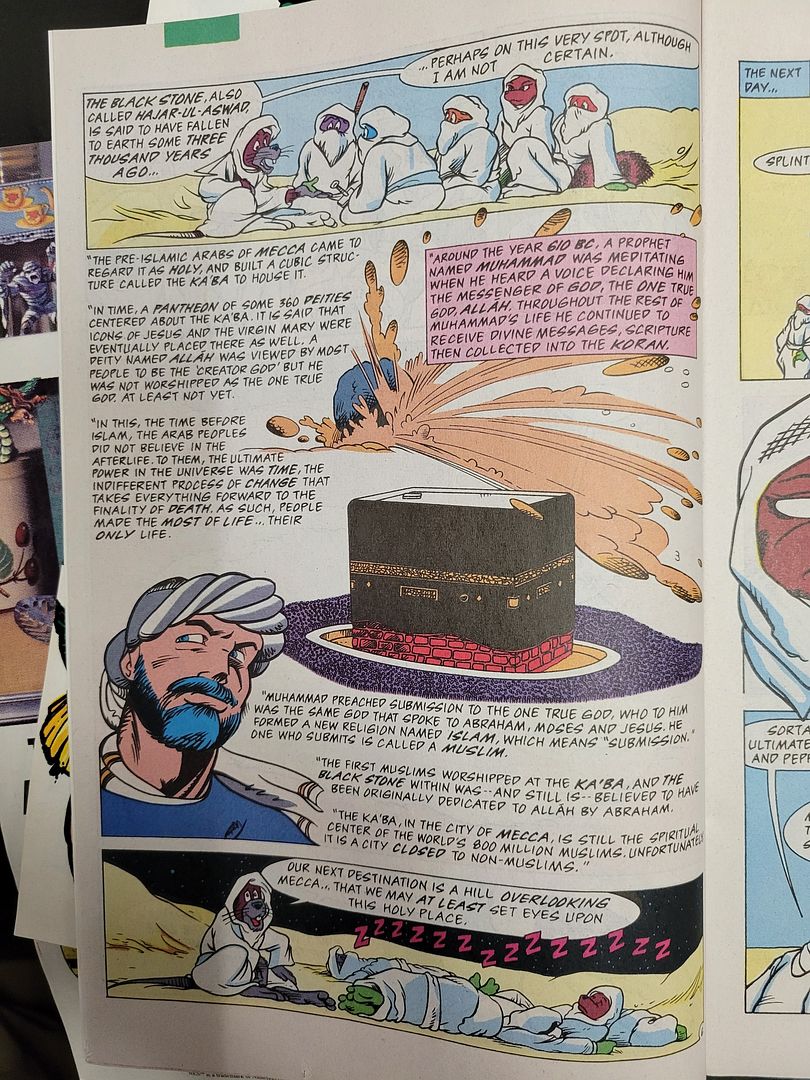
See, back in pre-9/11 times, most Americans knew nothing about Islam. And honestly, Clarrain wasn’t that far ahead of the rest of us. I’m pretty sure that dude in the middle is supposed to be Mohammad, which is a huge no-no, but there clearly weren’t a lot of Muslims reading Archie comics in 1992 and the Christian Moral Guardians had just had the entire Reagan-Bush era of running the government and were falling out of ascendance, so they weren’t combing through comics for things to be upset about. To the best of my knowledge, there wasn’t any scandal regarding this.
Anyway, it turns out Shredder is there to steal the Black Stone. The turtles meet Al’falqa and chase down Shredder and Verminator-X, but the villains disappear into a mysterious portal after the turtles recover the stone. (Shredder also lets Splinter go free because he owes the turtles for freeing him from Krang. Which creates some confusion in continuity, but we’ll get there.)
Then we hit a gap in my collection: I’m missing issues #36-40. TMNTPedia tells me that in #37 Cudley takes the turtles for a round of wrestling at Stump Asteroid; in #38-39 the turtes team up with the Mighty Mutanimals to fight the Four Horsemen of the Apocalypse and Null in Brazil; and in #40 a spirit takes Donatello to 1492 to try to defend the natives against Christopher Columbus, but he fails.
#41 is another Brammer story, a flashback to the earlier era framed by Raph and Ninjara on a date, in which an evil scientist clones a mammoth-mutant the turtles had previously encountered.
#42-44 are the best-named set of comics: The Future Shark Trilogy. It features a shark-mutant named Armaggon, who’s working to control the future with Shredder and Verminator-X, who had been sent back to retrieve the Black Stone of Mecca for their plans. Donatello and Raphael appear in a time portal and bring the present-day turtles, Ninjara, and Splinter into that future: A flooded New York City that Cudley had first revealed to them way back in #7. In the intervening decades, Splinter died of old age, the Greenhouse effect melted the ice caps, Donatello made a fortune inventing rat traps (and earned the ire of the Rat King), and his partner Manx became the evil cyborg Verminator-X. And then Donny invented time travel, digging out the crystal locator and finding the Second Eye of Sarnath (remember that dropped plot from #3-4?) to use as a power source. Armaggon and Verminator-X stole the time-slip generator (and the Eye, and kidnapped the other two turtles and Merdude), then plucked Shredder and the first Eye out of the timeline. The villains have been making limited jumps to the past to retrieve power sources for the generator, including nuclear fuel from Null’s schemes, the bones of the Roswell alien, Hitler’s brain, and the White Stone of Mecca. The turtles jump in before the villains can complete their plan, but an accident with the time-slip generator traps half of them with Armaggon in a strange fairy-filled realm called Thanatia. In issue #44, half the group fights the Rat King (come for revenge) and we answer a bit of turtles lore: Can the Rat King control Splinter? (Answer: Yes!). The other half defeats Armaggon and strands him in Thanatia, which the stinger reveals is a farther-future Earth. Then Future-Don retrieves the generator and sends everybody home, with seemingly only Verminator-X escaping.
It’s never explicitly stated when in the future this storyline takes place, but none of the human characters are mentioned in the future and the idea that the turtles could live more than 400 years is floated. (Raphael has a serious talk with himself about both his attitude and his romance with Ninjara.)
Shredder’s personal timeline becomes an ungodly mess, though: Armaggon picks him up from issue #4, taking the Eye of Sarnath and leaving Baxter behind. That Shredder appears in Saudi Arabia in #35 and steals the two Stones of Mecca (but loses the Black one). Then he loses to the turtles in #44 and presumably is sent back to #4, where he returns to plotting with Krang, gets sent to prison by Cherubae, escapes and copies Donny and Vid Vicious, gets Krang put on his head, and gets freed by the turtles. But then...how would he know in #36 that he “owes” the turtles (from #25) if, from his perspective, it hadn’t happened yet? (TMNTPedia claims they erased Shredder’s memory before sending him back; there’s nothing in the actual comic to support that. And it wouldn’t solve the problem. The TMNT Mutant Universe Sourcebook claims that Shredder escaped and remained in the future; perhaps an unpublished story was intended to bridge that with him being put back into #4.)
#45 is a one-shot with Mitchroney art that retells the Turtle’s origin, in case you’re a new reader or have forgotten it after all this time.
#46 is another one-shot starring Raph and Ninjara. We learn that Ninjara’s birth name is Umeko, and meet her brother Naga. They travel to the secret enclave of fox-people who Ninjara was estranged from and rescue her grandmother, with a side-trip through Yomi, the Underworld. But also, a giant robot shouting “Sarnath” appears in Central Park, so in #47 the rest of the team go and meet the giant robot whose eyes we’d been wondering about since issue #3. Seems the alien who showed up in #3 was a Mergia, creators of the Triasts (which Sarnath is one of). The robotic Triasts were kept as slaves, but revolted, seeking equal rights as sentient beings. When the Mergia lost, Sarnath’s master stole his eyes and fled. Sarnath eventually made it to Earth and found one of his eyes near the alien’s buried body in Central Park. Sarnath assimilates a news camera because he needs his other eyes to see, otherwise. (And the turtles have to break the bad news that Sarnath’s other two eyes are one hundred years in the future—which is not strictly accurate, as only one made the time-jump and the other stayed buried until future-Donny found it, but is good enough when you’re trying to prevent a paradox.) The turtles rescue Sarnath’s alien dog Qark, but are briefly caught on live-broadcast news cameras in the process. But that’s a problem for another day, because they pick up Raph and Ninjara and head for Dimension X in Sarnath’s ship.
#48-50 are the Black Hole Trilogy. They arrive in Dimension X to discover a new black hole has appeared, and they’re attacked by the Imperial Aerwyl Fleet who mistake them for “Nova Squadron.” The battle damages the ship, and it and Sarnath fall into the black hole while the turtles are rescued by Nova Posse—deserters from the Imperial fleet’s Nova Squadron. They convene with a bunch of guest stars at Stump Asteroid where an armada is massing; but then Don is abducted by the Sons of Silence.
Donny wakes up in a white void where the Sons appear to be worshiping the Turnstone, which Cherubae wished out of existence back in #13. Sarnath and a crashed Imperial fighter both appear, and we learn that the void is the inside of the black hole. And the Turnstone, somehow sapient and running the show, starts speaking to Donny. Meanwhile, the rest of the coalition goes to defeat Emperor Mazool of Aerwyl, who’s trying to use the chaos of the expanding black hole to conquer the remains of Dimension X. (Joke for adults that went over my head in 1993: The ship the turtles use is the Imperial Starship P’ntaang.)
Finally, in shiny-cover issue #50, Donny is possessed by the Turnstone and starts growing the black hole out of control. Sarnath frees him and takes the Turnstone, sending Donny to safety and banishing the Sons of Silence. (It seems to be that this entire crisis was manufactured by the Sons at the Turnstone’s behest, and they kidnapped Donny so the Turnstone could use him. Sarnath accidentally falling into the black hole saved the universe.) He then collapses the black hole on itself, seemingly destroy himself and the Turnstone in the process.
A side story: I didn’t read #50 in 1993. It had a shiny variant cover and the local comics shop didn’t order enough for the demand from collectors, so I didn’t know how the story ended for years. Then in 1999, I was at a high school party and struck up a conversation with a cute goth girl, and we ended up talking comic books. I mentioned that TMNT Adventures #50 was a white whale in my collection, and a month later she produced a copy for me for a birthday present. (The flirting never went anywhere and I lost touch with her not long after, but I’ll always be grateful that she went bin-diving for me.)
(Additional side note: I should think about editing TMNTPedia, because issues #49-54 are missing from it!)
In #51, the Chameleon returns, having significantly upgraded his shapeshifting abilities. He hunts down the turtles to see if they know how he might become human again...but they don’t, so oh well. In #52 we discover that Scumbug and Wyrm have been living in some sort of weird symbiosis in the sewer, but a new alien villain named Toxzeem freezes them into “crystal death” and they’re shattered. (During both issues, April’s reporter colleagues bumble their way through trying to get more footage of the turtles or other mutants and mostly fail.)
#53-54 are the two-part The Animus War storyline. An alien creature called Animus steals “The Scroll of the War of the Children of Light and Children of Darkness” from the Dead Sea Scroll collection in the Shrine of the Book in Jerusalem. Which, just starting off, um. UM. Then, continuing to remind us that it’s pre-9/11 America, April gets the turtles into Israel by packing them in her luggage. They arrive to a special news report about riots being lead by Al’falqa and Katmandu, who are clearly under mind control. Ariella Yahuda, the Israeli soldier who’s been keeping tabs on April reveals herself to be Golani, a blue-skinned Twi’lek-like being with magical superpowers. Animus has been called forth by the children of darkness he calls the Hashasheem (I’m guessing a misspelling of hashashim, the Islamic sect we get the word “assassins” from), in a ruin called Nimrod’s Fortress. They discover they can hurt Animus with light, but Mike is blinded during the battle. Eventually they hurt down Animus’ lair, steal back the dead sea scroll, causing him to weaken and shrink, so they seal him in a snow globe.
While all of this is going on, a 7-part backup story called “Megadeath” is also running in issues #48-54. (Just in case you wanted reassurance that the Moral Guardians still weren’t looking.) Future Don and Raph come back to try to change history, but by the end of it, all of the Mighty Mutanimals are dead anyway. This also features the return of Jim Lawson’s painfully terrible art. This leads directly into the Terracide trilogy, which I’ll pick up with next time.
In issues #55-57, “Terracide” picks up right after Megadeath (thankfully with Allen doing the art), as Future-Don and Future-Raph discover that the Mutanimals are dead, but that doesn’t match what was supposed to happen, indicating the timeline is being changed. Meanwhile, the plane the present turtles are taking back from Israel gets shot down (also not according to history), and Mikey gets captured by the coast guard. The turtles, along with Slash (seeking revenge for the death of his only friends) and Candy Fine (Mondo’s girlfriend) hunt down the “gang of four” that killed the Mutanimals and discover that Null is running the show and also has Skul and Bean on his side. When the gang of four are revealed to be robots and destroyed, Null kidnaps Candy and heads to the dark side of the moon, where Maligna’s hive world is hiding. Their ship is destroyed, but the spacebound party (Future-Don, both Raphs, Slash, Ninjara and Splinter) time-slip onto the hive world. (The rest of the turtles stayed on Earth to rescue Mike.) They damage the hive-world and slaughter the drones, and the damage sends the hive-world tumbling into the sun, and the time-slip remote is lost. Null escapes, and Slash stays behind to make sure Skul, Bean and Maligna all burn up as the party boards an escape shuttle.
Two side notes, both relating to the fact they weren’t bound to cartoon show standards & practices: The first is that the word “death” gets thrown around a lot, and we have extended scenes of the Mutanimals lying in pools of their own blood. The second is that Null uses mind control on Candy and clearly has turned her into a sex slave (wink, nudge, plausible deniability, she’s clearly just feeding him grapes in that dress) and I wonder what the average age of the readership was by this point. In 1993 I had certainly hit puberty, and as we noted, I was the prime demographic for this comic when it started.
(I’m missing #58; it’s apparently a one-shot flashback of “how the turtles got their colors” that Mike thinks about while in lockup. And Leo and Don meet up with Kid Terra and his men, who are interested in helping them.)
Meanwhile, on Earth, #59-60 are the “Blindsight” storyline. The evil reporter McIntyre who’s been trying to present the turtles as a menace since Sarnath landed gets April to appear on his talk show so he can twist her words. Fortunately, she’s no fool, so she has Oyuki seduce the AV Tech and put a video of the turtles rescuing Mike on live broadcast: It includes footage of the evil government scientist torturing Mike, but then Mike rescuing that scientist anyway when he almost drowns. The crowd interprets this as the turtles being heroes and McIntyre is thwarted. (From the art changes, it appears that Oyuki has aged from “kid” to “mid-teens” since we saw her last.) As the space team pilots an alien fighter back to Earth, they’re forced to land at Area 51 by strange government fighters. They escape with the help of a captive alien, but end up in a standoff between the rescue party and the reinforcements outside, so the alien agrees to return to captivity to let them go free. Don swears to come back for him. (But he probably won’t, because remember that Amaggon steals the alien’s bones to power the time-slip generator in the future.)
#61 opens with a funeral for Slash (and Lawson art, thankfully for the last time). The two Raphaels have another heart-to-heart, and the Future versions of Leo and Mike arrive with a human woman named Nobuko, who reveals herself to be April’s great-granddaughter. They contemplate the changes in history: In the original version, Maligna’s invasion sped along the greenhouse effect and she killed Slash and the Mutanimals; in this version they still died and man apparently wrecks the Earth’s climate all on our own. Kid Terra’s friend Sleeping Owl (who Splinter can apparently communicate with telepathically, because that’s just something meditating lets you do) tells a creation myth about the World Turtle.
Issues #62-66 are a story called “Dreamland” headlined by the Cyber Samurai Mutant Ninja Turtles (aka, the future turtles, but in mecha-armor that I vaguely recall being a new toyline at the time). And the opening panel finally gives a time to our future period: 2094. Continuing to bring home the “this comic isn’t for 8-year-olds any more” theme, Future-Raph has a nightmare and wakes up next to a naked foxwoman. (Mezcaal, presumably a descendent of Ninjara.) Verminator-X has built cyber-zombies and is out committing crimes, and seriously injures Mike.
Don fiddles with Armaggon’s souped-up time-slip generator (which he doesn’t know Hitler’s brain is attached to) and activates it enough that the brain can open portals to 1945. The turtles then go back to 1945, stop the Hilter’s brain-in-a-robot-body, punch Hitler himself in the face, and lose another time-slip remote before the automatic system retrieves them. Verminator-X, now working with the alien Crainiac to steal a bunch of important human brains before a rogue comet destroys Earth, lures the turtles into a pair of traps, where they fight both zombies and evil brains. Verminator-X breaks off his alliance when Crainiac wants to kill the turtles to take their brains, so Crainiac flees Earth alone. Raph shoots Verminator-X, in what plays like a serious “I did what had to be done” moment, but then Don rebuilds him into Manx again and they work together to shoot down the comet before Earth is destroyed.
The backup stories “The Angel of Times Square” involve April and decidedly adult-looking Oyuki investigating what seems to be a grifter selling tickets to see an angel. (The second issue reveals it’s a flash-forward to New Years Eve 1999.) April rescues woman being held captive, who may actually be an angel, and who encourages April to think about the beauty of the world as she flies away.
Issues #67-70 are the “Moon Eyes Saga”. The turtles and Ninjara travel with April to Alaska in pursuit of a story just as tensions start to flare between Raph and Ninjara about their relationship. They meet a werewolf named Mokoshan, who is smitten with Ninjara and nicknames her “Moon-Eyes.” There’s some hubbub with toxic waste creating mutant polar bears; but the thrust of this story is Ninjara falling out of love with Raphael and his bad attitude and pursuing something new.
And that’s where my collection of the main series ends. According to TMNTPedia, #71-72 were a flashback storyline called “The Early Years” that told how the turtles chose their weapons. The final story was supposed by a five-part epic called “The Forever War” uniting both eras of turtles and lots of guest stars. It was supposed to be finally published in 2009…and then as a fan-sponsored project in 2019…and the last updates I can find were that Chris Allen was drawing the fifth issue following Covid delays. So it might be dead again or it might actually appear online; but it doesn’t exist yet. Presumably it would tie together a bunch of loose ends, including the time-slip remote Don loses in 1945; Null’s escape and his hand in rewriting the history of Maligna’s invasion; and whatever happened to Shredder after he was properly returned to the timeline.
And one more bit: I have a few issues of the Mighty Mutanimals comics, a bunch of the standalone miniseries, and a fair number of specials released in 1993/1994.
TMNT Present Mighty Mutanimals (#1-3), reprinted as the single-volume Mighty Mutanimals: Invasion From Space, picks up from TMNTA #19, when Null has revealed his evil plan. Queen Maligna leads her first assault on the Earth, and the Mutanimals from Stump Asteroid come to Earth and meet up with the Earth-based ones in Brazil, where we learn of how Maligna attacks: Her larva eat all the vegetation and turn it into greenhouse gasses that wreck the ecosystem. Fortunately, the turtles and the Mutanimals stop the invasion with their usual flair. Contrast with the Terracide version of the fight against the larva (where the turtles explicitly slaughter them), the Mutanimals knock them out and Cudley ferries them to a “safe” area of Dimension X. Oh, and this makes it clearer that Kid Terra (who assists the turtles during the “Blindsight” arc) was originally a minion for Null who saw the error in his ways.
The following year, TMNT Present Mighty Mutanimals started as an ongoing series that lasted for 9 issues. Unfortunately, I only have #2 (where we learn more of Wingnut and Screwloose’s backstory) and #9 (where the Mutanimals rescue Slash from human captivity, learn that he was from a planet called “Palmtopia” that was destroyed by a warlord who cut down all the trees, and earn his eternal gratitude by setting him up on a palm tree covered nature preserve island.) #9 was published in June of 1993; the Megadeath backup story started in September of the same year. Given comic book lead times, Clarrain must have started planning to kill the Mutanimals before their own book had even finished its run.
TMNT Presents April O’Neil (#1-3) picks up after the events of TMNTA #33, when April, Oyuki and the Warrior Dragon return to the US. April gets fired and gets entangled in a Chinatown gang war, that turns out to be Chein Kahn’s doing: He had been a New York gangster until his rivals sealed him into a container ship, and he made a deal with a demon for survival (which turned him into a dog-man). After the demon was defeated, he was free to return to the states and seek revenge against his rivals and former master. Unfortunately for him, April tricks him into calling upon demon powers that attract the attention of the demon lord he failed…and he’s drawn into the underworld, never to be seen again. The ending sets up April’s new career as a freelance journalist with Oyuki as her camerawoman; and sets up an ongoing romance with Chu Hsi (the Warrior Dragon’s human host) that doesn’t seem to show up again.
TMNT Presents April O’Neil: The May East Saga (#1-3) follows immediately after in the publication schedule and isn’t the slightest bit related. In a story by Stanley Wiater with art by Bob Fingerman, we learn that April is descended from an ancient sorceress named Maiest (or “May East”) who is awakened on a forgotten island. Over the course of three issues April turns into a giant robot, demonstrates incredible ninja skill, shrinks into Splinter’s brain, and learns to trust the villain who cryptically vanishes. It's a particularly crazy story that thankfully ends up having no impact on the wider continuity, only noteworthy to me in that the second issue has a guest inker: My dad’s old partner-in-crime Stephen DeStefano.
TMNT Presents Donatello and Leatherhead (#1-3) – Donny and Leatherhead are working on random tech projects together when a mysterious UFO spirits them away to the Hollow Earth. There, they discover that time run differently and they run a gauntlet of people and animals from various eras of history and mythology. Dinosaurs! Giant turtles and alligators! Swamp witches! Amazons on flying horses! Atlantean aliens! This is another Stanley Wiater piece, but the Garret Ho / Marc Schirmeister art gives it a sense of whimsy. It’s random and ultimately comes to nothing, but it works as a cartoon-esque romp that you don’t expect anything from.
TMNT Presents Merdude (#1-3) – Entertainingly, this is another mini that actually connects into continuity in important ways. (It takes place after Future Shark but before the end of Megadeath.) The first issue features Merdude and Michaelangelo, who have to deal with Naughtikus, an ancient kracken-monster that awakens and threatens Earth…which is caused by Armaggon being picked up in the far future by aliens who he quickly conquers. The second issue is Merdude and Mondo Gecko, which ties into Megadeath as Future-Don helps build the new Mutanimals HQ, and involves Mondo and Candy getting back together. The third issue in nominally about Merdude and Ray Fillet, but it mostly revolves around Bloho (a parody of Lobo with Mister Mind’s powerset) taking brief control of Ray; and Armaggon getting a working time-slip generator which he uses to come back and enact revenge…but that eventually malfunctions and strands him somewhere in time and space. Bloho ends up on the neck of the comatose Naughtikus. Will that ever pay off? Not in any books I own!
Another interesting bit of lore this miniseries produced: Merdude is 5,000 years old; he was a Polynesian fisherman exposed to alien mutagen that merged him with a coelacanth. He theorizes that all mutagen-based lifeforms have the potential to live that long…which is extra tragic given that he’s telling this to Ray Fillet, who dies a few months later. (It’s actually probably something unique to Merdude or the mutagen that he was exposed to, given that Splinter canonically dies of old age somewhere between 1995 and 2092. Coelacanths only live about 60 years, so this isn’t like the turtles’ longevity coming from their inheritor species.)
TMNT Adventures Special (#3-11) – A quarterly book by an assortment of guest authors and artists; the closest it comes to the main continuity is that Stanley Wiater’s character Bookwurm appears a few times. Honestly, I think these are more what the higher-ups at Archie and the comic-buying parents expected from a TMNT comic book. The stories are all stand-alone and the ones that reference preexisting characters (such as Man Ray and Cudley) give you everything you need to know about them.
And that’s pretty much everything! If anyone else wants to read this, IDW actually reprinted the majority of the main series (skipping issues #32-36, which means that all the problematic Tibet and middle east material gets cut out) and including the original Mighty Mutanimals miniseries and Mighty Mutanimals #7, which apparently ties in to Future Shark.
Upon reflection, though the series was excellent at presenting recaps and flashbacks in case you missed a few issues, this was insanely continuity-heavy for a comic aimed at kids in the late 80s/early 90s; and clearly by 1992 the higher-ups at Archie weren’t paying any attention to what they were publishing. At the time, I thought that bringing back the eyes of Sarnath plotline four years later was brilliance; but I was a comic-collector child and re-read my old books constantly. I have to wonder how many kids had either picked up the series later or just had forgotten they’d ever read the older stories. Four years for the adult Spider-Man audience is nothing, but four years when it’s a third of your life so far?
There were a lot of clever ideas in the series, and they did a lot more with the “buy more toys” characters than I remember the TV show managing. The attempts to add cultural depth were clunky (I’m pretty sure the portrayals of Japan, Tibet, Israel, native American cultures, etc wouldn’t fly today), but it was a pre-internet era and they get credit for trying. The arc resolutions were very hit-or-miss; Clarrain was great at leaving every issue on a cliffhanger but had some real issues with pacing his climaxes and denouement. I remember this series fondly and the parts that stuck out to me as a kid seem to hold up.
In 1989 I was eight years old, and squarely in the demographic for these guys. I was also already a big comic fan and making weekly trips to the comics shop on top of all the free DC books my dad brought home. So I have a fairly complete collection of these. And I'm going to review and summarize the entire series.
Issues #1-4 directly adapted from the cartoon, taking the stories “The Return of Shredder” and “The Incredible Shrinking Turtles” in two issues each. Dave Garcia handles both the art and the adaptation of a script originally by Christy Marx and David Wise. Garcia doesn’t quite have a handle on good comic pacing and doesn’t really believe in backgrounds, but the art is decent and captures a lot of the action of the cartoon, if in a slightly slowed-down way. The second story ends with Shredder and Baxter Stockman escaping with the 1st Eye of Sarnath (an alien gem with mysterious powers). In the cartoon, this was the first of a four-part collection of episodes where each of the different eyes does something weird and eventually Shredder gets all three, attaches them to his helmet, and makes terrible use of matter-transforming powers until he’s defeated. In this series, the plot is dropped.
Issue #5 marks the introduction of writers Dean Clarrain and Ryan Brown, who’ll generally shepherd the series from here on. I don’t know what was going on behind the scenes, but it seems pretty clear there was an effort to diverge from the TV series but a requirement to use all of the characters they wanted to sell toys for. And so in Issue #5 we meet Man Ray, and in #6 Leatherhead. We also have a brief meeting with Swamp Witch Mary Bones, who transformed Leatherhead with her magic crystal ball. This will very shortly be the source of the series’ first retcon, which I find entertaining.
As a side note, "Dean Clarrain" was apparently a pen name for comic writer Stephen Murphy, a Mirage Comics staffer who later went on to be a staff writer for the 2003 TMNT show, and write the 2004 relaunch of the Tales of the TMNT comic. There’s a theory that this comic served to “insulate” the Mirage Comics TMNT line from the toy-driven, kid-friendly needs of the cartoon tie-in.
Issue #7 brings in Jim Lawson and Gary Fields as the art team, and they’re…not good. It also introduces Stump and Sling (who run an intergalactic wresting arena), the dimensional-traveling cow-head Cudley, and wrestlers Cryin’ Houn’ and Ace Duck. On the way home, Cudley accidentally brings them 100 years into the future (where global warming has caused ocean levels to rise), foreshadowing several later plotlines. Another interesting point is that the turtles are given new costumes for the wrestling match, and while three of them are discarded within two issues, Raphael keeps his all-black head-to-toe suit for quite some time.
Issues #8 introduces Wingnut and Screwloose, and is done by alternate art team Ken Mitchroney and Dan Berger, who are significantly more capable. (I feel like a decent number of the “Mutanimals” acquired different origins in the comics versus the cartoon. They’re more commonly aliens than former humans in the comics.) After that first foray into space, we then see a bunch of issues that hew very close to the TV series, taking place in New York and generally involving Shredder, Krang, Bebop and Rocksteady doing evil and various new mutants being created along the way. Issue #9 is done by Lawson/Fields and introduces the international superspy the Chameleon, who gets turned into an actual Chameleon when he’s captured by Shredder. Issue #10 introduces Scumbug and The Wyrm (and seemingly leaves them both dead) with Mitchroney/Berger art. This flip-flopping of art teams will continue for years.
Issue #11 looks like it’s going to be a normal foray against the Rat King (again with Lawson/Fields art) but opens with Bebop and Rocksteady being kidnapped by alien grays...which it’s later revealed are called the Sons of Silence and are being directed by Krang as he searches for Mary Bones and the “Turnstone”. And then we spend #12-13 back in space, it’s revealed that Mary Bones was secretly an alien warlord named Cherubae the whole time, and her crystal ball was actually the Turnstone. There’s a big battle, but then Leatherhead helps Cherubae regain the Turnstone, and she banishes Bebop and Rocksteady to a wild animal planet, Krang to Dumpworld, and Shredder to an Earth prison. (And removes the Turnstone itself from existence.) So right as we finish our first year of comics, we’ve had our first “final battle” featuring most of the new characters, and radically changed the status quo from the cartoon.
Issues #14-18 involve another round of one-shot stories and introducing new characters. A trip to the rainforest in Brazil introduces Jagwar and Dreadmon (and sees the return of Man Ray), and then we return to NYC to meet Mondo Gecko. We also get some nice strong environmentalist themes going, as the turtles raise concerns about destruction of rainforests, water pollution and bad fishing practices.
Issue #19 brings in a point that will recur both in later issues and later media: Splinter begins teaching April how to fight with a katana blade. We also establish some new villains, including an evil businessman named Null, who’s working with Queen Maligna and her alien bug lackeys, Scul and Bean. Raph and Mondo follow that plotline as it kickstarts the new Mighty Mutanimals series (starring Man-Ray, Jagwar, Dreadmon, Leatherhead, Wingnut and Screwloose), while in issue #20 the rest of the cast meet the Warrior Dragon (aka Hot Head).
#21 introduces Vid Vicious, a mutated master of technology who’s able to pull people in and out of cyberspace. While Donatello and Vid fight on a computer, Shredder breaks in and copies them both to a floppy disk, and destroys the original computer afterwards. This deserves special mention because Vid is actually an environmentalist villain: His plan is to use the nuclear waste that contaminated him to irradiate all of the world’s oil, so that world leaders will be forced to sit down and rethink policy. (It’s a terrible plan, but it’s shockingly “trying to do a good thing but going too far” for a cartoon villain of the era.) It’s also noteworthy that Donny apparently fits onto half of a floppy disk, and that the Donny who exists for the rest of the series is a computer clone of the original, who died in cyberspace.
In #22, Shredder extracts them from the disk (and Vid escapes, never to be seen again) to use Donny as bait to trap Splinter and get revenge, but he’s foiled at the last minute by Raphael, back from his adventures with the Mutanimals and back in his original red attire. (Shredder is never shown escaping from prison; it’s just assumed that he broke out and acquired some new Foot soldier robots at some point in the interim period.)
#23 picks up with Krang on Morbius, the Dump-world, where he meets Slash, an alien turtle inexplicably searching for a palm tree. They team up with Bellybomb, hijack a ship, and go retrieve Bebop and Rocksteady. Then they catch up with the Turtles and Shredder, and #24 ends with Krang placing himself over Shredder’s head and taking over his body.
This makes for a fantastic image, but also raises a lot of questions: Can Krang take over any body? Why hasn’t he done it earlier? Why take Shredder specifically when there are much stronger (and dumber) mutants around? The battle in #25 is a little disappointing, but the Turtles free Shredder and defeat Krang. Bebop and Rocksteady, having had their fun, drop Krang and Bellybomb back on Morbius and return to their beloved animal planet. (There’s also a series of backup stories featuring April and the Warrior Dragon.)
Issues #5-25 were also republished in the Teenage Mutant Ninja Turtles Classics Digest series #1-7, and in some ways that first two years of the comic felt like the “definitive” run to me, despite the fact that a third of the issues had the terrible Lawson/Fields art. There’s clearly a bunch of push-and-pull with the desire to introduce new characters and the desire to create ongoing plots with them; and the desire to get away from the Shredder/Krang villain dynamic and the requirement to appeal to fans of the cartoon. By the time the series ended in 1995 I was in middle school and reading pretty much DC’s entire product line (including some Vertigo stuff I probably shouldn’t have been), so it occupies my brain differently.
After the big wrap-up in #25, Dean Clarrain takes a break from scripting duties and Doug Brammer steps in for two issues. In #26 Master Splinter is telepathically contacted by a Tibetan yeti named T’Pau with dire warnings, and he and the turtles are teleported to Tibet and then abducted by the alien Boss Salvage. Salvage isn’t a villain, though, he’s just trying to save rare species from dying worlds, and fears human pollution will destroy Earth.
In #27, April gets stranded in Innsmouth, MA where a trio of animals mutated by toxic waste are getting revenge by feeding the waste to the townspeople and turning them into zombies.
These two issues also continue the April/Splinter backup stories, which lead directly into the Midnight Sun trilogy in #28-30. (This is also the point where Chris Allen becomes the main artist on the series, and he is notably better than any of the teams before him.) The Turtles, along with April and Splinter, travel to Japan to rescue the Warrior Dragon, who they learn was kidnapped by Chien Khan and his sidekick Ninjara. Chein Kahn’s plan is to use magic to control the Warrior Dragon, have him attack a nuclear plant and cause a meltdown, and use the energy from that to create a gateway to the wold of demons. As the battle rages, Splinter meditates and summons the creators Izanagi and Izanami, who seal away the demon. In the aftermath, Kahn escapes, but Ninjara has a change of heart and decides to accompany the turtles. An interesting side part of this story is that it reveals that Splinter was born in 1930, and in 1945 he and his great-uncle witnessed the destruction of Hiroshima. So in 1991, he’s old for a man and ancient for a rat.
Over the next few issues, the turtles travel across Japan and then continue across Asia. In issue #33 the human characters fly back to the US (including Oyuki, who becomes April’s ward/sidekick in the background of the rest of the series), and Splinter, Ninjara and the turtles begin a wider pilgrimage, first across China to Tibet. #33 also introduces the four-armed tiger Katmandu, and then #34 the great spiritual leader (and former mentor to Splinter) the Charlie Llama. In #35 they continue to the middle east, where we learn the story of The Black Stone of Mecca. (And the lost White Stone.) Which includes a comic page that could be published in 1992 but boy oh boy...not ten years later. Or today.
See, back in pre-9/11 times, most Americans knew nothing about Islam. And honestly, Clarrain wasn’t that far ahead of the rest of us. I’m pretty sure that dude in the middle is supposed to be Mohammad, which is a huge no-no, but there clearly weren’t a lot of Muslims reading Archie comics in 1992 and the Christian Moral Guardians had just had the entire Reagan-Bush era of running the government and were falling out of ascendance, so they weren’t combing through comics for things to be upset about. To the best of my knowledge, there wasn’t any scandal regarding this.
Anyway, it turns out Shredder is there to steal the Black Stone. The turtles meet Al’falqa and chase down Shredder and Verminator-X, but the villains disappear into a mysterious portal after the turtles recover the stone. (Shredder also lets Splinter go free because he owes the turtles for freeing him from Krang. Which creates some confusion in continuity, but we’ll get there.)
Then we hit a gap in my collection: I’m missing issues #36-40. TMNTPedia tells me that in #37 Cudley takes the turtles for a round of wrestling at Stump Asteroid; in #38-39 the turtes team up with the Mighty Mutanimals to fight the Four Horsemen of the Apocalypse and Null in Brazil; and in #40 a spirit takes Donatello to 1492 to try to defend the natives against Christopher Columbus, but he fails.
#41 is another Brammer story, a flashback to the earlier era framed by Raph and Ninjara on a date, in which an evil scientist clones a mammoth-mutant the turtles had previously encountered.
#42-44 are the best-named set of comics: The Future Shark Trilogy. It features a shark-mutant named Armaggon, who’s working to control the future with Shredder and Verminator-X, who had been sent back to retrieve the Black Stone of Mecca for their plans. Donatello and Raphael appear in a time portal and bring the present-day turtles, Ninjara, and Splinter into that future: A flooded New York City that Cudley had first revealed to them way back in #7. In the intervening decades, Splinter died of old age, the Greenhouse effect melted the ice caps, Donatello made a fortune inventing rat traps (and earned the ire of the Rat King), and his partner Manx became the evil cyborg Verminator-X. And then Donny invented time travel, digging out the crystal locator and finding the Second Eye of Sarnath (remember that dropped plot from #3-4?) to use as a power source. Armaggon and Verminator-X stole the time-slip generator (and the Eye, and kidnapped the other two turtles and Merdude), then plucked Shredder and the first Eye out of the timeline. The villains have been making limited jumps to the past to retrieve power sources for the generator, including nuclear fuel from Null’s schemes, the bones of the Roswell alien, Hitler’s brain, and the White Stone of Mecca. The turtles jump in before the villains can complete their plan, but an accident with the time-slip generator traps half of them with Armaggon in a strange fairy-filled realm called Thanatia. In issue #44, half the group fights the Rat King (come for revenge) and we answer a bit of turtles lore: Can the Rat King control Splinter? (Answer: Yes!). The other half defeats Armaggon and strands him in Thanatia, which the stinger reveals is a farther-future Earth. Then Future-Don retrieves the generator and sends everybody home, with seemingly only Verminator-X escaping.
It’s never explicitly stated when in the future this storyline takes place, but none of the human characters are mentioned in the future and the idea that the turtles could live more than 400 years is floated. (Raphael has a serious talk with himself about both his attitude and his romance with Ninjara.)
Shredder’s personal timeline becomes an ungodly mess, though: Armaggon picks him up from issue #4, taking the Eye of Sarnath and leaving Baxter behind. That Shredder appears in Saudi Arabia in #35 and steals the two Stones of Mecca (but loses the Black one). Then he loses to the turtles in #44 and presumably is sent back to #4, where he returns to plotting with Krang, gets sent to prison by Cherubae, escapes and copies Donny and Vid Vicious, gets Krang put on his head, and gets freed by the turtles. But then...how would he know in #36 that he “owes” the turtles (from #25) if, from his perspective, it hadn’t happened yet? (TMNTPedia claims they erased Shredder’s memory before sending him back; there’s nothing in the actual comic to support that. And it wouldn’t solve the problem. The TMNT Mutant Universe Sourcebook claims that Shredder escaped and remained in the future; perhaps an unpublished story was intended to bridge that with him being put back into #4.)
#45 is a one-shot with Mitchroney art that retells the Turtle’s origin, in case you’re a new reader or have forgotten it after all this time.
#46 is another one-shot starring Raph and Ninjara. We learn that Ninjara’s birth name is Umeko, and meet her brother Naga. They travel to the secret enclave of fox-people who Ninjara was estranged from and rescue her grandmother, with a side-trip through Yomi, the Underworld. But also, a giant robot shouting “Sarnath” appears in Central Park, so in #47 the rest of the team go and meet the giant robot whose eyes we’d been wondering about since issue #3. Seems the alien who showed up in #3 was a Mergia, creators of the Triasts (which Sarnath is one of). The robotic Triasts were kept as slaves, but revolted, seeking equal rights as sentient beings. When the Mergia lost, Sarnath’s master stole his eyes and fled. Sarnath eventually made it to Earth and found one of his eyes near the alien’s buried body in Central Park. Sarnath assimilates a news camera because he needs his other eyes to see, otherwise. (And the turtles have to break the bad news that Sarnath’s other two eyes are one hundred years in the future—which is not strictly accurate, as only one made the time-jump and the other stayed buried until future-Donny found it, but is good enough when you’re trying to prevent a paradox.) The turtles rescue Sarnath’s alien dog Qark, but are briefly caught on live-broadcast news cameras in the process. But that’s a problem for another day, because they pick up Raph and Ninjara and head for Dimension X in Sarnath’s ship.
#48-50 are the Black Hole Trilogy. They arrive in Dimension X to discover a new black hole has appeared, and they’re attacked by the Imperial Aerwyl Fleet who mistake them for “Nova Squadron.” The battle damages the ship, and it and Sarnath fall into the black hole while the turtles are rescued by Nova Posse—deserters from the Imperial fleet’s Nova Squadron. They convene with a bunch of guest stars at Stump Asteroid where an armada is massing; but then Don is abducted by the Sons of Silence.
Donny wakes up in a white void where the Sons appear to be worshiping the Turnstone, which Cherubae wished out of existence back in #13. Sarnath and a crashed Imperial fighter both appear, and we learn that the void is the inside of the black hole. And the Turnstone, somehow sapient and running the show, starts speaking to Donny. Meanwhile, the rest of the coalition goes to defeat Emperor Mazool of Aerwyl, who’s trying to use the chaos of the expanding black hole to conquer the remains of Dimension X. (Joke for adults that went over my head in 1993: The ship the turtles use is the Imperial Starship P’ntaang.)
Finally, in shiny-cover issue #50, Donny is possessed by the Turnstone and starts growing the black hole out of control. Sarnath frees him and takes the Turnstone, sending Donny to safety and banishing the Sons of Silence. (It seems to be that this entire crisis was manufactured by the Sons at the Turnstone’s behest, and they kidnapped Donny so the Turnstone could use him. Sarnath accidentally falling into the black hole saved the universe.) He then collapses the black hole on itself, seemingly destroy himself and the Turnstone in the process.
A side story: I didn’t read #50 in 1993. It had a shiny variant cover and the local comics shop didn’t order enough for the demand from collectors, so I didn’t know how the story ended for years. Then in 1999, I was at a high school party and struck up a conversation with a cute goth girl, and we ended up talking comic books. I mentioned that TMNT Adventures #50 was a white whale in my collection, and a month later she produced a copy for me for a birthday present. (The flirting never went anywhere and I lost touch with her not long after, but I’ll always be grateful that she went bin-diving for me.)
(Additional side note: I should think about editing TMNTPedia, because issues #49-54 are missing from it!)
In #51, the Chameleon returns, having significantly upgraded his shapeshifting abilities. He hunts down the turtles to see if they know how he might become human again...but they don’t, so oh well. In #52 we discover that Scumbug and Wyrm have been living in some sort of weird symbiosis in the sewer, but a new alien villain named Toxzeem freezes them into “crystal death” and they’re shattered. (During both issues, April’s reporter colleagues bumble their way through trying to get more footage of the turtles or other mutants and mostly fail.)
#53-54 are the two-part The Animus War storyline. An alien creature called Animus steals “The Scroll of the War of the Children of Light and Children of Darkness” from the Dead Sea Scroll collection in the Shrine of the Book in Jerusalem. Which, just starting off, um. UM. Then, continuing to remind us that it’s pre-9/11 America, April gets the turtles into Israel by packing them in her luggage. They arrive to a special news report about riots being lead by Al’falqa and Katmandu, who are clearly under mind control. Ariella Yahuda, the Israeli soldier who’s been keeping tabs on April reveals herself to be Golani, a blue-skinned Twi’lek-like being with magical superpowers. Animus has been called forth by the children of darkness he calls the Hashasheem (I’m guessing a misspelling of hashashim, the Islamic sect we get the word “assassins” from), in a ruin called Nimrod’s Fortress. They discover they can hurt Animus with light, but Mike is blinded during the battle. Eventually they hurt down Animus’ lair, steal back the dead sea scroll, causing him to weaken and shrink, so they seal him in a snow globe.
While all of this is going on, a 7-part backup story called “Megadeath” is also running in issues #48-54. (Just in case you wanted reassurance that the Moral Guardians still weren’t looking.) Future Don and Raph come back to try to change history, but by the end of it, all of the Mighty Mutanimals are dead anyway. This also features the return of Jim Lawson’s painfully terrible art. This leads directly into the Terracide trilogy, which I’ll pick up with next time.
In issues #55-57, “Terracide” picks up right after Megadeath (thankfully with Allen doing the art), as Future-Don and Future-Raph discover that the Mutanimals are dead, but that doesn’t match what was supposed to happen, indicating the timeline is being changed. Meanwhile, the plane the present turtles are taking back from Israel gets shot down (also not according to history), and Mikey gets captured by the coast guard. The turtles, along with Slash (seeking revenge for the death of his only friends) and Candy Fine (Mondo’s girlfriend) hunt down the “gang of four” that killed the Mutanimals and discover that Null is running the show and also has Skul and Bean on his side. When the gang of four are revealed to be robots and destroyed, Null kidnaps Candy and heads to the dark side of the moon, where Maligna’s hive world is hiding. Their ship is destroyed, but the spacebound party (Future-Don, both Raphs, Slash, Ninjara and Splinter) time-slip onto the hive world. (The rest of the turtles stayed on Earth to rescue Mike.) They damage the hive-world and slaughter the drones, and the damage sends the hive-world tumbling into the sun, and the time-slip remote is lost. Null escapes, and Slash stays behind to make sure Skul, Bean and Maligna all burn up as the party boards an escape shuttle.
Two side notes, both relating to the fact they weren’t bound to cartoon show standards & practices: The first is that the word “death” gets thrown around a lot, and we have extended scenes of the Mutanimals lying in pools of their own blood. The second is that Null uses mind control on Candy and clearly has turned her into a sex slave (wink, nudge, plausible deniability, she’s clearly just feeding him grapes in that dress) and I wonder what the average age of the readership was by this point. In 1993 I had certainly hit puberty, and as we noted, I was the prime demographic for this comic when it started.
(I’m missing #58; it’s apparently a one-shot flashback of “how the turtles got their colors” that Mike thinks about while in lockup. And Leo and Don meet up with Kid Terra and his men, who are interested in helping them.)
Meanwhile, on Earth, #59-60 are the “Blindsight” storyline. The evil reporter McIntyre who’s been trying to present the turtles as a menace since Sarnath landed gets April to appear on his talk show so he can twist her words. Fortunately, she’s no fool, so she has Oyuki seduce the AV Tech and put a video of the turtles rescuing Mike on live broadcast: It includes footage of the evil government scientist torturing Mike, but then Mike rescuing that scientist anyway when he almost drowns. The crowd interprets this as the turtles being heroes and McIntyre is thwarted. (From the art changes, it appears that Oyuki has aged from “kid” to “mid-teens” since we saw her last.) As the space team pilots an alien fighter back to Earth, they’re forced to land at Area 51 by strange government fighters. They escape with the help of a captive alien, but end up in a standoff between the rescue party and the reinforcements outside, so the alien agrees to return to captivity to let them go free. Don swears to come back for him. (But he probably won’t, because remember that Amaggon steals the alien’s bones to power the time-slip generator in the future.)
#61 opens with a funeral for Slash (and Lawson art, thankfully for the last time). The two Raphaels have another heart-to-heart, and the Future versions of Leo and Mike arrive with a human woman named Nobuko, who reveals herself to be April’s great-granddaughter. They contemplate the changes in history: In the original version, Maligna’s invasion sped along the greenhouse effect and she killed Slash and the Mutanimals; in this version they still died and man apparently wrecks the Earth’s climate all on our own. Kid Terra’s friend Sleeping Owl (who Splinter can apparently communicate with telepathically, because that’s just something meditating lets you do) tells a creation myth about the World Turtle.
Issues #62-66 are a story called “Dreamland” headlined by the Cyber Samurai Mutant Ninja Turtles (aka, the future turtles, but in mecha-armor that I vaguely recall being a new toyline at the time). And the opening panel finally gives a time to our future period: 2094. Continuing to bring home the “this comic isn’t for 8-year-olds any more” theme, Future-Raph has a nightmare and wakes up next to a naked foxwoman. (Mezcaal, presumably a descendent of Ninjara.) Verminator-X has built cyber-zombies and is out committing crimes, and seriously injures Mike.
Don fiddles with Armaggon’s souped-up time-slip generator (which he doesn’t know Hitler’s brain is attached to) and activates it enough that the brain can open portals to 1945. The turtles then go back to 1945, stop the Hilter’s brain-in-a-robot-body, punch Hitler himself in the face, and lose another time-slip remote before the automatic system retrieves them. Verminator-X, now working with the alien Crainiac to steal a bunch of important human brains before a rogue comet destroys Earth, lures the turtles into a pair of traps, where they fight both zombies and evil brains. Verminator-X breaks off his alliance when Crainiac wants to kill the turtles to take their brains, so Crainiac flees Earth alone. Raph shoots Verminator-X, in what plays like a serious “I did what had to be done” moment, but then Don rebuilds him into Manx again and they work together to shoot down the comet before Earth is destroyed.
The backup stories “The Angel of Times Square” involve April and decidedly adult-looking Oyuki investigating what seems to be a grifter selling tickets to see an angel. (The second issue reveals it’s a flash-forward to New Years Eve 1999.) April rescues woman being held captive, who may actually be an angel, and who encourages April to think about the beauty of the world as she flies away.
Issues #67-70 are the “Moon Eyes Saga”. The turtles and Ninjara travel with April to Alaska in pursuit of a story just as tensions start to flare between Raph and Ninjara about their relationship. They meet a werewolf named Mokoshan, who is smitten with Ninjara and nicknames her “Moon-Eyes.” There’s some hubbub with toxic waste creating mutant polar bears; but the thrust of this story is Ninjara falling out of love with Raphael and his bad attitude and pursuing something new.
And that’s where my collection of the main series ends. According to TMNTPedia, #71-72 were a flashback storyline called “The Early Years” that told how the turtles chose their weapons. The final story was supposed by a five-part epic called “The Forever War” uniting both eras of turtles and lots of guest stars. It was supposed to be finally published in 2009…and then as a fan-sponsored project in 2019…and the last updates I can find were that Chris Allen was drawing the fifth issue following Covid delays. So it might be dead again or it might actually appear online; but it doesn’t exist yet. Presumably it would tie together a bunch of loose ends, including the time-slip remote Don loses in 1945; Null’s escape and his hand in rewriting the history of Maligna’s invasion; and whatever happened to Shredder after he was properly returned to the timeline.
And one more bit: I have a few issues of the Mighty Mutanimals comics, a bunch of the standalone miniseries, and a fair number of specials released in 1993/1994.
TMNT Present Mighty Mutanimals (#1-3), reprinted as the single-volume Mighty Mutanimals: Invasion From Space, picks up from TMNTA #19, when Null has revealed his evil plan. Queen Maligna leads her first assault on the Earth, and the Mutanimals from Stump Asteroid come to Earth and meet up with the Earth-based ones in Brazil, where we learn of how Maligna attacks: Her larva eat all the vegetation and turn it into greenhouse gasses that wreck the ecosystem. Fortunately, the turtles and the Mutanimals stop the invasion with their usual flair. Contrast with the Terracide version of the fight against the larva (where the turtles explicitly slaughter them), the Mutanimals knock them out and Cudley ferries them to a “safe” area of Dimension X. Oh, and this makes it clearer that Kid Terra (who assists the turtles during the “Blindsight” arc) was originally a minion for Null who saw the error in his ways.
The following year, TMNT Present Mighty Mutanimals started as an ongoing series that lasted for 9 issues. Unfortunately, I only have #2 (where we learn more of Wingnut and Screwloose’s backstory) and #9 (where the Mutanimals rescue Slash from human captivity, learn that he was from a planet called “Palmtopia” that was destroyed by a warlord who cut down all the trees, and earn his eternal gratitude by setting him up on a palm tree covered nature preserve island.) #9 was published in June of 1993; the Megadeath backup story started in September of the same year. Given comic book lead times, Clarrain must have started planning to kill the Mutanimals before their own book had even finished its run.
TMNT Presents April O’Neil (#1-3) picks up after the events of TMNTA #33, when April, Oyuki and the Warrior Dragon return to the US. April gets fired and gets entangled in a Chinatown gang war, that turns out to be Chein Kahn’s doing: He had been a New York gangster until his rivals sealed him into a container ship, and he made a deal with a demon for survival (which turned him into a dog-man). After the demon was defeated, he was free to return to the states and seek revenge against his rivals and former master. Unfortunately for him, April tricks him into calling upon demon powers that attract the attention of the demon lord he failed…and he’s drawn into the underworld, never to be seen again. The ending sets up April’s new career as a freelance journalist with Oyuki as her camerawoman; and sets up an ongoing romance with Chu Hsi (the Warrior Dragon’s human host) that doesn’t seem to show up again.
TMNT Presents April O’Neil: The May East Saga (#1-3) follows immediately after in the publication schedule and isn’t the slightest bit related. In a story by Stanley Wiater with art by Bob Fingerman, we learn that April is descended from an ancient sorceress named Maiest (or “May East”) who is awakened on a forgotten island. Over the course of three issues April turns into a giant robot, demonstrates incredible ninja skill, shrinks into Splinter’s brain, and learns to trust the villain who cryptically vanishes. It's a particularly crazy story that thankfully ends up having no impact on the wider continuity, only noteworthy to me in that the second issue has a guest inker: My dad’s old partner-in-crime Stephen DeStefano.
TMNT Presents Donatello and Leatherhead (#1-3) – Donny and Leatherhead are working on random tech projects together when a mysterious UFO spirits them away to the Hollow Earth. There, they discover that time run differently and they run a gauntlet of people and animals from various eras of history and mythology. Dinosaurs! Giant turtles and alligators! Swamp witches! Amazons on flying horses! Atlantean aliens! This is another Stanley Wiater piece, but the Garret Ho / Marc Schirmeister art gives it a sense of whimsy. It’s random and ultimately comes to nothing, but it works as a cartoon-esque romp that you don’t expect anything from.
TMNT Presents Merdude (#1-3) – Entertainingly, this is another mini that actually connects into continuity in important ways. (It takes place after Future Shark but before the end of Megadeath.) The first issue features Merdude and Michaelangelo, who have to deal with Naughtikus, an ancient kracken-monster that awakens and threatens Earth…which is caused by Armaggon being picked up in the far future by aliens who he quickly conquers. The second issue is Merdude and Mondo Gecko, which ties into Megadeath as Future-Don helps build the new Mutanimals HQ, and involves Mondo and Candy getting back together. The third issue in nominally about Merdude and Ray Fillet, but it mostly revolves around Bloho (a parody of Lobo with Mister Mind’s powerset) taking brief control of Ray; and Armaggon getting a working time-slip generator which he uses to come back and enact revenge…but that eventually malfunctions and strands him somewhere in time and space. Bloho ends up on the neck of the comatose Naughtikus. Will that ever pay off? Not in any books I own!
Another interesting bit of lore this miniseries produced: Merdude is 5,000 years old; he was a Polynesian fisherman exposed to alien mutagen that merged him with a coelacanth. He theorizes that all mutagen-based lifeforms have the potential to live that long…which is extra tragic given that he’s telling this to Ray Fillet, who dies a few months later. (It’s actually probably something unique to Merdude or the mutagen that he was exposed to, given that Splinter canonically dies of old age somewhere between 1995 and 2092. Coelacanths only live about 60 years, so this isn’t like the turtles’ longevity coming from their inheritor species.)
TMNT Adventures Special (#3-11) – A quarterly book by an assortment of guest authors and artists; the closest it comes to the main continuity is that Stanley Wiater’s character Bookwurm appears a few times. Honestly, I think these are more what the higher-ups at Archie and the comic-buying parents expected from a TMNT comic book. The stories are all stand-alone and the ones that reference preexisting characters (such as Man Ray and Cudley) give you everything you need to know about them.
And that’s pretty much everything! If anyone else wants to read this, IDW actually reprinted the majority of the main series (skipping issues #32-36, which means that all the problematic Tibet and middle east material gets cut out) and including the original Mighty Mutanimals miniseries and Mighty Mutanimals #7, which apparently ties in to Future Shark.
Upon reflection, though the series was excellent at presenting recaps and flashbacks in case you missed a few issues, this was insanely continuity-heavy for a comic aimed at kids in the late 80s/early 90s; and clearly by 1992 the higher-ups at Archie weren’t paying any attention to what they were publishing. At the time, I thought that bringing back the eyes of Sarnath plotline four years later was brilliance; but I was a comic-collector child and re-read my old books constantly. I have to wonder how many kids had either picked up the series later or just had forgotten they’d ever read the older stories. Four years for the adult Spider-Man audience is nothing, but four years when it’s a third of your life so far?
There were a lot of clever ideas in the series, and they did a lot more with the “buy more toys” characters than I remember the TV show managing. The attempts to add cultural depth were clunky (I’m pretty sure the portrayals of Japan, Tibet, Israel, native American cultures, etc wouldn’t fly today), but it was a pre-internet era and they get credit for trying. The arc resolutions were very hit-or-miss; Clarrain was great at leaving every issue on a cliffhanger but had some real issues with pacing his climaxes and denouement. I remember this series fondly and the parts that stuck out to me as a kid seem to hold up.


